To protect an insurance claim as a new homeowner, photograph every room, all four exterior sides, the roof from the ground, and every major system with its serial number, then store the photos in a dated cloud folder, not just your camera roll. Do this in your first week, before furniture goes in if possible, and repeat it every year. The five biggest US home insurers closed 44% of claims last year without paying, most often citing missing documentation or 'lack of upkeep.' Photos plus a record of professional servicing is the difference between a paid claim and a denied one.
Reporting in June 2026 found that the five biggest US home insurers closed 44% of homeowner claims the prior year without paying. Nearly half. The most common gap between a paid claim and a denied one was not the type of damage or the policy language. It was documentation. No before photos. No maintenance records. No proof the damage was sudden rather than gradual neglect.
Meanwhile, the average US water-damage claim runs $13,954 (Insurance Information Institute), and 1 in 60 insured homes files one every year. That is real money at real odds, and the difference between recovering it and absorbing it yourself comes down to 20 minutes of work you should have done in your first week.
This guide covers exactly what to photograph, what to store, what policy gaps to close, and how your maintenance records become the single most valuable financial asset in your house when something goes wrong. For the full room-by-room shot list, see Home Inventory: 30 Photos in 20 Minutes for Insurance.
Insurance Documentation Checklist for New Homeowners
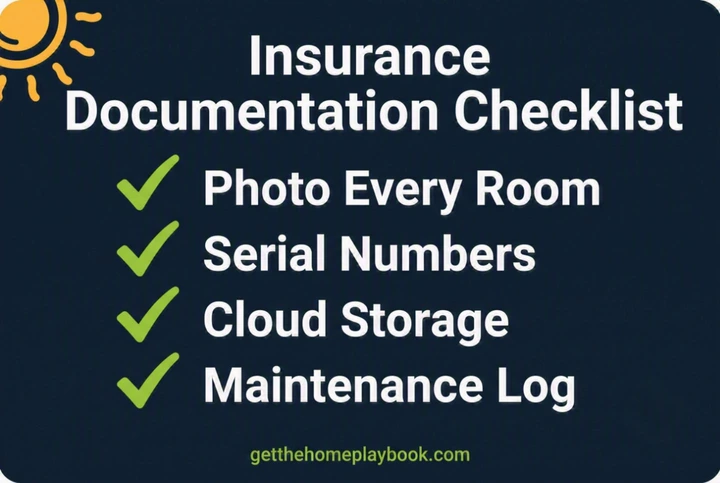
Your Insurance Photo Baseline: Do This in Week 1
A before photo of your roof taken three months ago is worth more than your word when a storm hits. Insurance companies pay claims based on documented evidence. Without it, they classify damage as pre-existing or gradual, and both are excluded from most policies.
In your first 30 days as a homeowner, this is one of the highest-value 20-minute tasks you can do. Here is exactly what to capture.
Interior Photos
Photograph every room from multiple angles. Get the ceiling, all four walls, and the floor in each room. Open closets and photograph inside. Photograph under every sink. Get close-ups of any existing damage, stains, or wear so the insurer cannot claim it happened after your loss event.
Exterior Photos
Photograph all four sides of the house. Photograph the roof from the ground (binoculars help, but the camera matters more). Photograph the foundation, driveway, patio, deck, fencing, and any outbuildings. Include the landscaping and grading near the foundation.
Systems and Appliances
Photograph every major system and appliance with the serial number and model number visible. This includes the water heater, HVAC unit (indoor and outdoor), furnace, fridge, washer, dryer, dishwasher, and any built-in appliances. These photos prove age, condition, and replacement value.
Storage
Create a cloud folder labeled "Home Baseline 2026-07" (or whatever month you move in). Upload everything there. Do not rely on your camera roll alone. If your phone is lost, stolen, or damaged in the same event that damages your house, your evidence goes with it. Google Drive, iCloud, or Dropbox all work. The point is that it is accessible from anywhere, backed up, and dated.
Taking the photos but leaving them in the camera roll. A phone that gets water-damaged in the same flood that damages your house takes your evidence with it. Cloud storage is not optional. And skipping the serial numbers on appliances means you cannot prove their age or replacement value when you file a claim.
DIY vs Hire: DIY: photograph every room and system yourself; it costs nothing but time. Call a pro (a licensed appraiser) only if you need a formal valuation for high-value items.
The 6 Coverage Gaps Most New Homeowners Do Not Know About
Most new homeowners assume their policy covers everything. It does not. Here are the gaps that cost the most when you find them at claim time instead of policy review time.
| Coverage Area | Common Default | What to Check | Cost to Fix the Gap |
|---|---|---|---|
| Water damage | Often excludes gradual | Check "sudden" vs "gradual" wording. Gradual is almost always excluded. Water and freezing account for roughly a quarter of all US home claims. | Policy-dependent |
| Sewer backup | Often excluded entirely | Add a rider. Sewer backup remediation easily exceeds $10,000. | $50 to $100/year for rider |
| Mould remediation | Limited to $5,000 to $10,000 | Understand your actual limit. Full remediation can run $3,000 to $30,000+. | Higher limit rider varies |
| Roof (age-based) | May exclude roofs 15+ years old | Read your policy terms on roof age. Some policies pay actual cash value, not replacement cost, on older roofs. | Varies by insurer |
| Dwelling coverage amount | Often set at purchase price | Must equal CURRENT rebuild cost, not purchase price. Update annually. Rebuild cost can be 20 to 40% higher than market price. | Premium increase varies |
| Personal property | Actual cash value | Upgrade to replacement cost coverage. ACV pays what your 8-year-old fridge is worth today. Replacement cost pays what a new one costs. | Small premium increase |
Five minutes on the phone with your insurer now is cheaper than finding any of these gaps after a claim. If you are also reviewing your first-year maintenance budget, factor in the cost of any riders you add.
A sewer backup rider costs $50 to $100 per year and covers $10,000 or more in repairs. Most standard policies exclude sewer backup entirely. This is one of the highest-value single changes you can make to your policy. Ask your insurer today.
Knowing the policy gap is one thing. Knowing what a sewer problem actually looks and smells like is another. If you ever notice a sulphur smell coming from a drain in your house, read the sewer smell diagnosis guide before calling anyone. The most common cause costs $0 to fix. And if you spot a water stain on your ceiling, the water stain diagnosis guide walks you through active vs old damage in under five minutes.
Why Your Maintenance Log Is Your Most Valuable Financial Asset
Insurance companies routinely deny claims for "lack of upkeep." A history of professional servicing proves that damage was sudden and accidental, not gradual neglect. Your maintenance log is the counter-evidence.
Every time a contractor does work on your house, record four things: contractor name, date, scope of work, and cost. Keep receipts in a physical folder AND photographed in your cloud folder. This record does three jobs:
For insurance claims: it proves the damage was not caused by deferred maintenance. An HVAC service receipt from March proves the system was maintained when it fails in July. Without the receipt, the insurer can argue the failure was due to neglect.
When you sell: documented maintenance logs add thousands to your sale price and dramatically increase buyer confidence. Home inspectors specifically note whether maintenance records exist.
For your own planning: after 12 months of logging, you have a real baseline of what your house costs to maintain. That data is more useful than any estimate because it is your house, your systems, your contractors.
Keeping receipts but not keeping a log. A pile of receipts in a drawer does not tell the story of consistent maintenance. A dated log with scope and cost for each job does. When an adjuster reviews your claim, they want a clear timeline, not a shoebox.

2026 Upgrade Worth Knowing: Smart Water Leak Sensors
Water damage is the most likely five-figure claim you will ever file. 1 in 60 insured homes files a water-damage claim every year, and the 2026 US average runs $13,954 per claim.
A $30 to $150 smart leak sensor placed under the water heater, washing machine, and kitchen sink catches leaks before they flood. The sensor alerts your phone the moment it detects water, giving you minutes to act instead of hours of undetected flooding.
Many insurers now offer premium discounts for installing them. Ask yours. One prevented claim pays for the sensors hundreds of times over. Even if your insurer does not discount, three sensors for $90 to $450 total is cheap insurance on a $13,954 average claim.
Documented vs Undocumented: What the Numbers Look Like
The dollar difference between having documentation and not having it is not theoretical. These are the real-world outcomes.
| Scenario | With Documentation | Without Documentation |
|---|---|---|
| Water damage claim ($13,954 avg) | Paid in full. Before photos prove pre-loss condition. | Denied or reduced. Insurer claims pre-existing damage. |
| Storm damage to roof | Paid. Annual inspection receipts prove maintenance. | Denied for "lack of upkeep" or "wear and tear." |
| HVAC failure in heatwave | Covered if sudden. Service records prove it was maintained. | Classified as neglect. $5,000 to $12,000+ out of pocket. |
| Mould found in bathroom | Covered up to policy limit. Photos show it was not present at baseline. | Denied as gradual or pre-existing. $3,000 to $30,000+ remediation. |
| Selling your home | Maintenance log adds buyer confidence and supports asking price. | No records. Inspector flags lack of documentation. Price negotiated down. |
Twenty minutes of photos in week one. A few minutes per contractor visit to log the receipt. That is the total cost of documentation. The return is measured in thousands.
🛡️ Want the complete insurance documentation guide plus the full 12-month system?
HomePlaybook Mastery includes the step-by-step insurance documentation protocol, photo baseline templates, the full 47-task priority calendar, contractor scripts, cost tables, and the Audio Edition.
Get HomePlaybook Mastery. $44 →🛡️ Save $370 or it's free guarantee
Documentation protects you after something goes wrong. The Home Maintenance Cost Calculator helps you get ahead of it by showing what preventive maintenance should cost, so a denied claim never becomes your only option.
Emergency Fund Math
A $400,000 home runs $4,000 to $8,000 a year in maintenance. That $300 task you just found should come out of that fund, not credit. The average first-year surprise runs $5,356. Put $700 aside this month; that is your buffer. Run your own numbers with the Home Maintenance Cost Calculator.
Frequently Asked Questions
What should new homeowners photograph for insurance documentation?
Photograph every room including ceilings, floors, and walls. Photograph all four exterior sides, the roof from the ground, the foundation, and the driveway. Photograph every major appliance and system with the serial and model number visible. Store everything in a dated cloud folder labeled "Home Baseline" with the year and month. Do this in your first week, before furniture goes in if possible.
Why do home insurance claims get denied?
The most common reason for denial is no proof of pre-loss condition. Without before photos and maintenance records, insurers classify damage as gradual or caused by lack of upkeep. Both are excluded from most policies. Reporting in June 2026 found the five biggest US home insurers closed 44% of claims the prior year without paying.
What home insurance coverage gaps should new homeowners check for?
The most common gaps are: gradual water damage exclusion, sewer backup exclusion, mould remediation limits of $5,000 to $10,000, roof age exclusions for roofs over 15 years, and dwelling coverage set to purchase price instead of current rebuild cost. Adding a sewer backup rider costs $50 to $100 a year and covers $10,000 or more in repairs.
How do maintenance records help with insurance claims?
A history of professional servicing proves that damage was sudden and accidental rather than caused by neglect. Insurance companies routinely deny claims for "lack of upkeep." Your maintenance log with contractor receipts, dates, scope of work, and costs is the counter-evidence. Keep every receipt in a physical folder and photographed in your cloud folder.
Should I update my home insurance documentation every year?
Yes. Repeat the full photo baseline every year in the same month. Change over time is your evidence. Also review your policy annually to confirm dwelling coverage matches current rebuild cost, not purchase price, and check that any new home improvements or major purchases are covered.
Are smart water leak sensors worth installing for insurance purposes?
Yes. Water damage is the most likely five-figure claim you will ever file. The Insurance Information Institute reports the 2026 US average water-damage claim at $13,954, and 1 in 60 insured homes files one every year. A $30 to $150 smart leak sensor under the water heater, washing machine, and kitchen sink catches leaks before they flood. Many insurers now offer premium discounts for installing them.
What is the average cost of a home insurance water damage claim?
The 2026 US average water-damage claim is $13,954 according to the Insurance Information Institute. 1 in 60 insured homes files one every year. Water and freezing account for roughly a quarter of all US home insurance claims.
How much does a sewer backup insurance rider cost?
A sewer backup rider typically costs $50 to $100 per year and covers $10,000 or more in repairs. Most standard policies exclude sewer backup entirely. Given that sewer backup remediation can easily exceed $10,000, this is one of the highest-value riders available to homeowners.
This article is for informational and educational purposes only. It does not constitute professional, legal, or financial advice. Always consult with licensed professionals and review your specific policy terms before making insurance decisions. Cost estimates and claim statistics are 2026 US figures and vary by insurer, region, and individual policy.
Liked This? Get the Full System
Get the full 12-month system: 47 tasks, contractor scripts, and the Audio Edition. Save $370 or it's free.
Get HomePlaybook Mastery. $44 →Or get the free $5K Mistake Checklist